Page sections
Scan the major sections before moving into the full technical detail.
Engineering-first. Crypto-agilityCrypto-agilityBeing able to swap one encryption algorithm for another without rebuilding your systems. It is what turns the next migration into a configuration change instead of a project. always.
Talk to our security teamDrop-in fabric, not forklift replacement
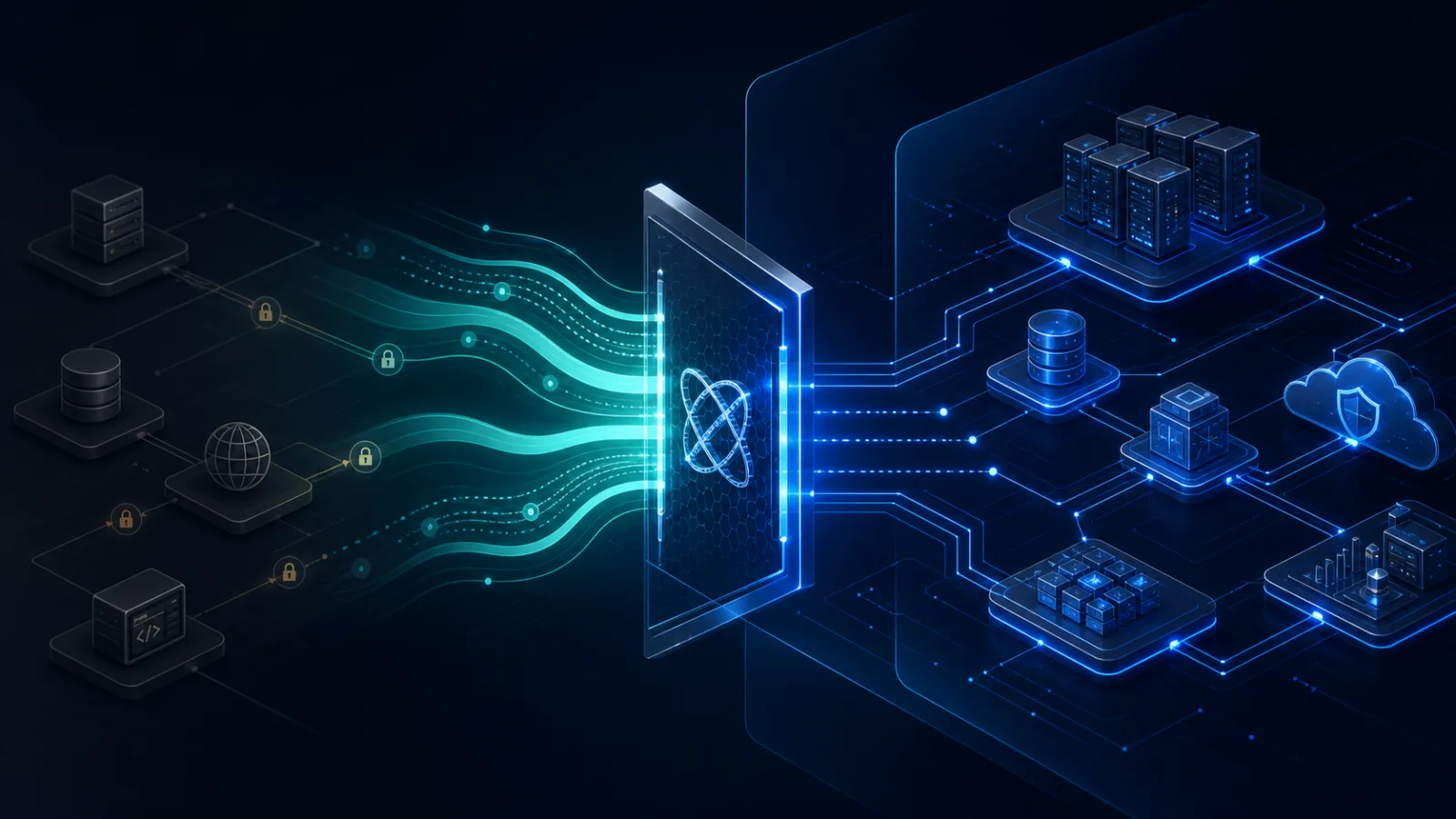
The most common reason PQC migration programmes stall is the perceived scale of the change. Security teams understand that RSA and ECDHECDHThe method almost every encrypted connection uses today to agree on a secret key. It is one of the two things a quantum computer would break, which is why ML-KEM replaces it. need to go. What stops them is the assumption that replacing them means touching every application that uses TLS, every service that signs a payload, every HSM that stores a private key. Quanten’s approach is explicitly designed to break that assumption. We operate at the layer below the application: the TLS termination boundary, the message-signing middleware, the key management API. Applications see the same interfaces they always have. The cryptographic substrate beneath those interfaces changes.
We describe this as a drop-in fabric because the operational model mirrors how network overlays work: the fabric handles a specific concern — in this case, key exchange and signing — transparently to the systems sitting above it. Deploying ML-KEM-1024ML-KEM-1024The NIST-standardised way for two systems to agree on a secret key without a quantum computer being able to work it out. It replaces the key exchange used by most of the internet today. hybrid mode on a TLS terminator requires no changes to the ten backend services it fronts. That is the design goal, and it is the reason our engagements typically reach a PQC-capable state faster than clients expect.
Crypto-agilityCrypto-agilityBeing able to swap one encryption algorithm for another without rebuilding your systems. It is what turns the next migration into a configuration change instead of a project. as a first-order requirement
A migration to today’s NIST-standardised algorithms — ML-KEM-1024ML-KEM-1024The NIST-standardised way for two systems to agree on a secret key without a quantum computer being able to work it out. It replaces the key exchange used by most of the internet today., ML-DSA-87, SLH-DSA — is not a one-time event. Algorithm recommendations will evolve. HQC-256 has been selected by NIST as a backup KEM, and FN-DSA/Falcon remains on the signature-standardisation track. Cryptanalytic results may change the security estimates for lattice-based constructions (they have not so far, but a 30-year security assumption is not the same as certainty). Regulatory bodies will update their approved-algorithm lists. An organisation that migrates to ML-KEM-1024 today and treats that as a closed problem has not actually achieved cryptographic resilience — it has just bought time.
This is why crypto-agilityCrypto-agilityBeing able to swap one encryption algorithm for another without rebuilding your systems. It is what turns the next migration into a configuration change instead of a project. is not an optional feature in Quanten’s platform — it is the central design constraint. Algorithm selection, parameter sets, and negotiation preferences are managed as versioned configuration profiles that can be updated and pushed to deployed nodes without application restarts or downtime. The operational cost of changing algorithm is deliberately designed to be near zero, so that future updates to the standards landscape do not trigger a new multi-year migration programme.
Partnership model and long-term accountability
Post-quantum migration is not a project with a defined end date — it is an ongoing security discipline. Quanten structures its engagements to reflect that. Initial delivery includes the crypto inventory, the migration roadmap, and the first set of production deployments. Ongoing engagement covers algorithm profile updates as standards evolve, annual re-assessment of the risk register as the CRQC timeline sharpens, and incident-response support in the event of a significant cryptanalytic development affecting a deployed algorithm.
We do not design our engagements to maximise scope. The goal is the smallest possible change that delivers the largest reduction in harvest-now-decrypt-later exposure. That means we will sometimes recommend against deploying a feature of our platform if simpler alternatives achieve the same risk reduction faster. Clients who need a straightforward answer more than a comprehensive solution will get that answer. Talk to us to start with a no-obligation scoping conversation.